How Alex Pollack ’97 Leads National Geographic’s Visual Storytelling
Behind every magazine headline, there are really two stories—the words on the page and the imagery that brings them to live. The latter is where visual storytellers like Alex Pollack ’97 come in. As National Geographic’s director of photography, Pollack I s shaping the way we see the world—one extraordinary image at a time.

The Integrity of the Image
Pollack’s career as a photo director has taken her from museums and glossy magazines to celebrity shoots and, finally, to the magazine known for its distinctive yellow border. She’s led photography teams at some of the most prominent names in publishing—including Bon Appétit (which won a National Magazine Award for photography under her leadership), Goop, Apple, Bustle Digital Group, and New York magazine. Joining National Geographic in 2024 felt, to Pollack, like coming full circle.
“After I graduated from UMass Boston, I had so many different jobs and wore so many hats,” she said. “I was an anthropology major with a history minor. People and cultures have always interested me. I went through a career in photography, covering all kinds of content before coming back to the subjects I’ve most wanted to explore. It’s a dream, honestly.”
That dream comes with a high bar, even for someone with Pollack’s depth of experience. National Geographic, she said, is a world apart from any other publication. For more than a century, it has set the gold standard for visual storytelling, guided by a mission that spans beyond the page. Founded in 1888 as a nonprofit scientific and educational organization, the National Geographic Society supports scientists, conservationists, and storytellers—known as “Explorers”—whose work inspires people to care about the planet and each other.
An insistence on authenticity is foundational to the magazine’s identity, and it’s something Pollack admires.
“I appreciate the care we take as an entity for authenticity. We don’t retouch images,” she explained. “We never alter a journalistic image. It’s just a rule.”
Pollack is quick to point out how radical that policy is in an age of digital manipulation, filters, and AI-generated imagery. For someone who has spent years in the sphere of lifestyle and celebrity photography, the absence of retouching is both a challenge and a point
of pride.
“National Geographic has always been fiercely protective of its archive, ensuring that every image reflects reality exactly as the eye sees it—straight from the camera, untouched. That level of integrity is extraordinary, and achieving it is anything but easy,” she said.
Finding the Spark
This ethos extends beyond pixels to the core of how stories are built at National Geographic. Rather than simply handing out assignments, Pollack and her team often collaborate closely with photographers who come to them with passion projects—some-times years, even a lifetime, in the making.
Take, for instance, a recent story on India’s Similipal Tiger Reserve. The photographer, Prasenjeet Yadav, grew up in the region, his life shaped by the animals he set out to document. He returned to India and spent 120 days in pursuit of a single goal: to capture the perfect image of a rare pseudo-melanistic tiger.
For Pollack, translating the work of someone like Yadav into a powerful 25-page magazine feature is both daunting and exhilarating. That balancing act—between honoring a photographer’s vision and upholding National Geographic’s rigorous standards—calls for editorial intuition and discernment across her team.
“It’s a group effort among all of us at the magazine,” Pollack explained. “We’re always asking ourselves, ‘How can we demonstrate the urgency and make it more compelling? Is there a character that we can latch onto? How can we get people to care? How do we tug some heartstrings?’ It’s just a completely different approach than anything else
I’ve done.” With her team of 22 and a nonstop influx of pitches from fellow visionaries, Pollack relies on her sharp eye for talent. She’s constantly on the lookout for photographers whose work stands out—those who can deliver an extraordinary image and a portfolio with a creative voice. Every week, her team reviews work from across the globe, always searching for something truly special, whether it’s a fully formed idea or a single outstanding piece.
“If you send me a truly exceptional image, I’m going to track down who you are and explore the rest of your work,” Pollack said. “For us, it has to be something that really stands out—something distinctive and compelling.”
Behind the Lens, Beyond the Camera
Pollack believes strongly in creating opportunities for new voices in photography. One initiative she supports is the National Geographic Society’s Second Assistant Program, which pairs experienced professionals with emerging photographers, offering them a meaningful entry point into photojournalism and documentary storytelling.
“Shooting for National Geographic can feel out of reach for many,” she said. “I want to help change that. My goal is to make the process more equitable and open doors for those who’ve historically had a harder time breaking through.”
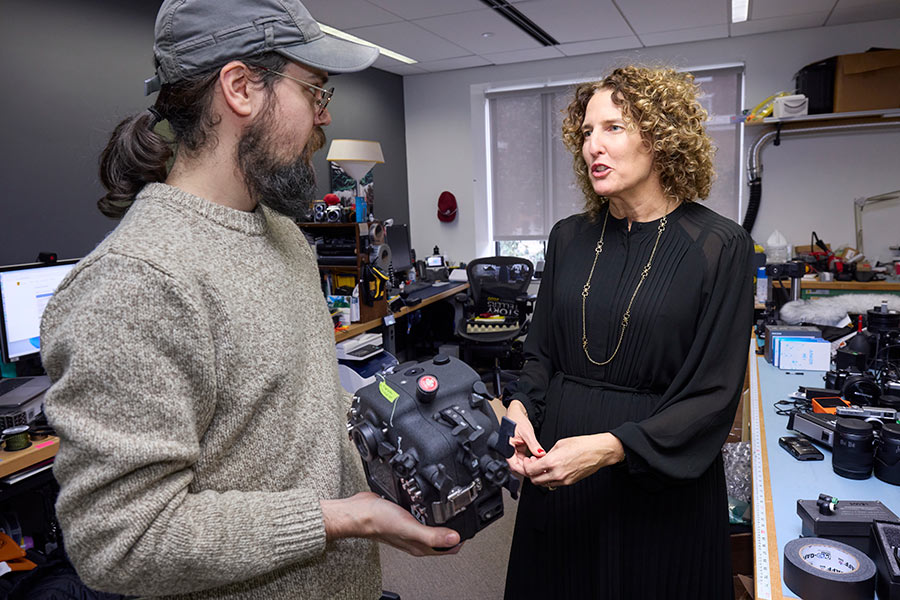
Technical mastery remains non-negotiable at the magazine—particularly in specialized fields like underwater photography. “You can’t just jump into the water with a camera and expect to capture the shot,” Pollack said. “It requires a deep understanding of both the craft and the environment.”
But while technique is essential, it’s the stories themselves, and the work behind the lens, that are central to Pollack’s work. In the past year alone, she’s worked with scientists involved in medical breakthroughs like the first successful pig-to-human kidney transplant; field researchers uncovering new animal adaptations that challenge long-held assumptions; and photographers returning from remote corners of the world with images of beavers reshaping river systems in mere days. All the while, she’s followed ambitious, years-long projects like Yadav’s exploration of tiger migration across India. Each story arrives with its own set of unique challenges, and each demands a visual narrative that can carry its full weight.
“It’s true storytelling. You have to go from the beginning and figure out, ‘How are we going to capture this?’” Pollack said.
The Thread That Ties It All Together
For all her editorial acumen, Pollack’s proudest achievements revolve around something beyond the pages of any publication: her ability to foster connection.
“I really care about people and cultures deeply. Every place I’ve gone, I’m proud that I have brought people together and bridged gaps. I’m a good connector,” she said.
This people-first philosophy traces back, in part, to Pollack’s formative years at UMass Boston. Within the university’s classrooms, and through relationships with faculty who recognized her spark, her dual passions for anthropology and storytelling began to emerge.
“A couple of the teachers I had at UMass Boston really helped steer this career and my love of anthropology. I had an independent study with one professor who was amazing. I just remember so much of what he talked to me about one-on-one. It was a wonderful experience. And a history professor, Dr. Bookbinder—just the way he told stories about World War II brought the material to life in a way I had not experienced previously. I felt like I wanted to make my own documentary films of these stories after I’d come out of his class.”
Those early lessons—about the power of storytelling, the importance of human connection, and the thrill of learning some-thing new—have stayed with Pollack ever since. It’s what makes National Geographic such a natural fit for her: There’s always another question to uncover, another world to explore.
“The opportunity to hear about these fascinating subjects, cutting-edge stuff like new animal adaptations, new archaeology, new ways to think about our world, new discoveries that are changing the way we thought about everything… it’s just fascinating content day to day. I’m constantly learning. That’s the best part. And I hope everyone has some part of that in their day-to-day work.”