Over 20 Years, Cancer Partnership Has Trained Hundreds of Researchers
The partnership between UMass Boston and the Dana-Farber/Harvard Cancer Center has supported 493 trainees, allowing them to gain practical experience in cancer research. As the partnership enters the fifth year of its current NIH grant, its leaders and supporters look back on what they’ve accomplished.
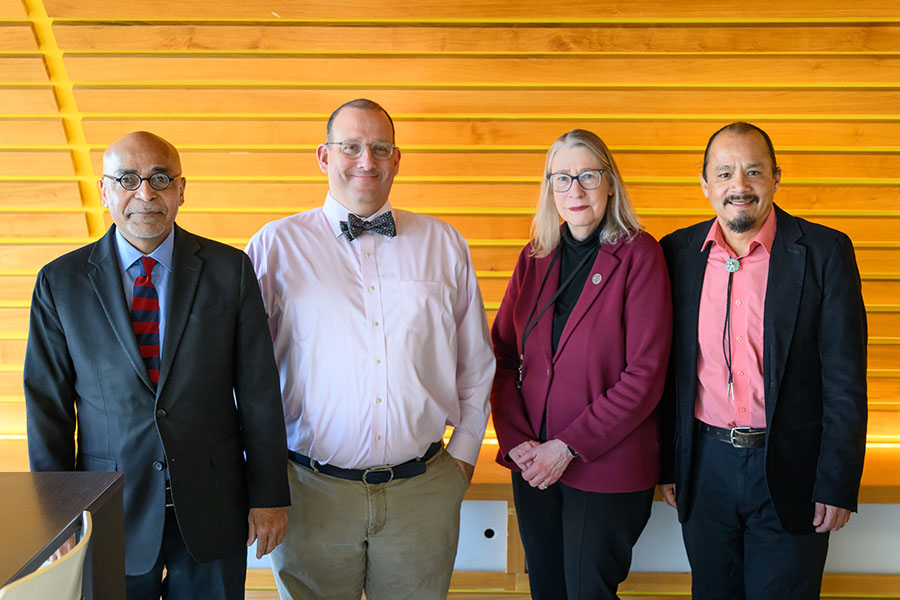
The Partnership was formally forged in 2005 when staff at UMass Boston and Dana Farber/Harvard Cancer Center (DF/HCC) jointly applied for an NIH/National Cancer Institute (NCI) grant. At the time, DF/HCC had access to more advanced scientific infrastructure, and UMass Boston had the diverse student population and connections to the local community that could lead to a successful collaboration. This was exactly the kind of partnership that the NIH/NCI grant was intended to support.
With this U56 funding and two subsequent U54 grants, the Partnership has grown to support hundreds of trainees across dozens of disciplines. It is run by equal numbers of staff from UMass Boston and Harvard, working together to give UMass Boston students a clear path to participating in cancer research.
From its inception, the Partnership has directed trainees into important areas of research where their studies can make an impact, such as basic and population sciences. Most trainees joining the program today are undergraduates, but many stay on to expand on their work as they move into graduate studies.
Some students from the Partnership have even returned to UMass Boston as faculty and staff, joining dozens of other new investigators who have been attracted to the cancer research community at UMass Boston. Faculty participants in the program can apply for three different levels of funding for their projects, depending on their needs: seed, pilot or full funding, which can provide up to $450,000 over three years to support a major study. Their research has also garnered support from outside organizations: Since 2010, faculty in the Partnership have received a total of 234 grants, collectively securing more than $111,700,000 in funding for their research.
“What this means is that faculty who are engaged in research with us, in partnership with us, are successful. They stick with it,” said Adán Colón-Carmona, a professor of biology at UMass Boston and one of four principal investigators of the U54 grant. “And they build their research programs here at UMass Boston, and their whole research portfolio may have been initiated by the partnership.”
Jill Macoska, the director of the Center for Personalized Cancer Therapy (CPCT) at UMass Boston, has led the way in securing funding, successfully competing for several awards from the Massachusetts Life Sciences Center to expand cancer research facilities. The CPCT, which grew out of the UMass Boston/Harvard Partnership, is the focus of cancer research at UMass Boston, and has trained more than 100 high school, undergraduate, and graduate students in cancer biology scholarship and research. The CPCT’s Genomics Core now has instruments that can analyze cancer biopsies down to the sub-cellular level, and others that can track the growth of mouse tumors in living mice. The CPCT has recently acquired a liquid-handling robot, sparing researchers from hours of tedious, repetitive pipetting as they prepare samples for experiments.
Of course, some pipetting will still be taking place: Practicing basic lab skills has immense value for trainees. Not all trainees stay in academia after graduating, and becoming comfortable in a research environment helps aspiring scientists to secure valuable internships and entry-level jobs. According to Macoska, the program works with the non-profit group MassBioEd to introduce trainees to the many opportunities that are open to them, including positions at pharmaceutical companies, startups, and public health departments. “Having these training programs has helped us make a bridge to industry, to offer these internships to our students because they've already had a lab experience,” Macoska said. Through cultivating partnerships with local biotech companies, the partnership has also helped trainees find opportunities through job fairs and internship programs.
Not all cancer research takes place in a lab; the Partnership also prepares students for community-based cancer research. The Outreach Core connects trainees with local organizations that want to offer cancer-related programs, such as screenings or educational events. From faith-based organizations to community health centers, the partnerships facilitated by the Outreach Core ensure that trainees get practical experience in working directly with people impacted by cancer.
Tiffany Donaldson, co-head of the Outreach Core at UMass Boston, said that “a lot of our students, who tend to be first gen and tend to be from diaspora communities, are not given a very broad sense of how they could be in a health profession. So we view this an opportunity to broaden our students’ views of what it means to be in a career that isn't just nursing and medical, or working at a bench.” In her roles as Associate Dean for Innovative Research and Community Partnerships and director of the School for Global Inclusion and Social Development in the College of Education and Human Development, Donaldson has seen mutual enthusiasm for the program from both students and the organizations they connect with.
Donaldson’s counterpart at the DF/HCC, Shoba Ramanadhan, an Associate Professor at the Harvard T.H. Chan School of Public Health, added, “The idea of relationship and community is central to what makes this set of internships and student relationships different. It’s centering the folks who are going to be those next generation of changemakers, whether it's in cancer, or in public health, or something else.”
Even students who don’t plan on going into the life sciences have benefitted. To date, the Partnership has supported trainees in fields from statistics to economics to computer science. According to Colón-Carmona, “The fact that we're bringing the different departments to work on major initiatives, I think, has strengthened us as an institution, because it's promoting collaboration, across departments and across colleges.”
Through the connections and relationships that the Partnership has built, students and faculty alike have prospered—and many of them intend to continue helping students to enter the world of cancer research, no matter what the future holds. Colón-Carmona takes pride in the scope of what the program has become, and what its participants have accomplished. “In my opinion, we wouldn't be an R1 research university today, if we didn't have this Partnership.”